

 English
 русский
Screw Washers Explained: Common Types, Materials, and How to Choose the Right One
 2026.08.03
 Industry news
A screw washer is a thin, flat component placed under a screw head or between two joined surfaces to distribute clamping load, prevent loosening, protect the material being fastened, or create a weatherproof seal. While washers seem like a minor detail compared to the screw itself, the wrong washer choice can lead to joint loosening, material damage, or water infiltration — making washer selection an important part of any fastening specification rather than an afterthought.
Why Washers Matter in a Fastened Joint
A washer's primary job is to spread the clamping force of a screw head over a wider surface area than the head alone would cover, reducing the pressure (force per unit area) applied to the material underneath. This matters most with soft materials like wood or plastic, where a screw head driven directly against the surface can crush fibers, crack the material, or gradually pull through under load or vibration.
Washers also serve secondary functions depending on their design: preventing a screw from backing out under vibration, creating a compressible seal against water or air infiltration, or providing electrical insulation between dissimilar metals to reduce galvanic corrosion.
Common Types of Screw Washers
Different washer designs solve different problems, and choosing the wrong type is one of the most common — and easily avoidable — fastening mistakes.
| Washer Type | Primary Function | Typical Application |
|---|---|---|
| Flat washer | Distributes load, protects surface | General-purpose fastening |
| Split lock washer | Spring tension resists loosening | Vibration-prone machinery joints |
| Toothed (star) lock washer | Teeth bite into surfaces for grip and grounding | Electrical grounding, light-duty locking |
| Fender washer | Large outer diameter for wide load spread | Soft materials like wood, sheet metal, drywall |
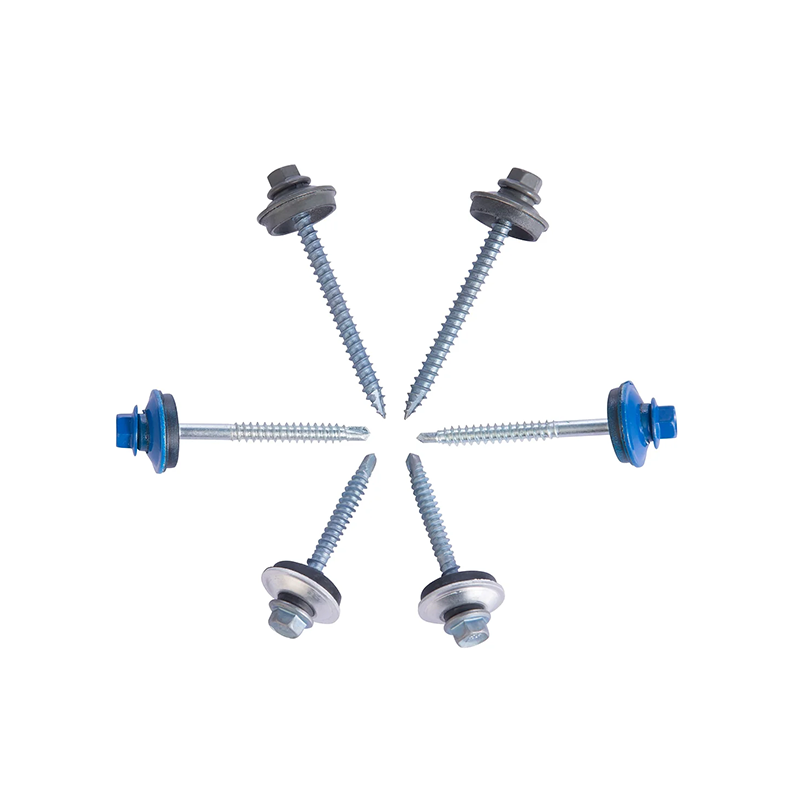
| Sealing (bonded) washer | Rubber-bonded to metal for a compressible seal | Roofing screws, outdoor waterproof fastening |
| Belleville (spring) washer | Cone shape provides consistent spring preload | High-vibration or thermal-cycling joints |
Split lock washers remain the most commonly used anti-loosening washer in general hardware, though engineering studies have increasingly questioned their effectiveness compared to properly torqued flat washers or thread-locking compounds — meaning they shouldn't be treated as a substitute for correct installation torque in critical joints.
Materials Used in Screw Washers
Washer material should match the screw and base material to avoid galvanic corrosion, and should suit the environment the joint will be exposed to.
- Zinc-plated steel: The most common and economical option for general indoor use
- Stainless steel: Strong corrosion resistance, standard choice for outdoor, marine, or washdown environments
- Nylon/plastic: Electrically insulating and non-marring, used where metal-to-metal contact must be avoided
- Copper or brass: Non-sparking and corrosion-resistant, used in electrical and some marine hardware
- EPDM-bonded rubber (on sealing washers): Provides a weatherproof seal that remains flexible across a wide temperature range
When fastening dissimilar metals — such as a stainless steel screw into an aluminum panel — using a nylon or other non-conductive washer as a barrier can help reduce galvanic corrosion at the contact point, which is a common cause of premature fastener failure in outdoor metal roofing and siding applications.
Washer Sizing and Fit
A washer must be sized correctly relative to the screw to function properly — too small an inner diameter and it won't fit over the shank, too large and it won't seat securely under the screw head.
| Screw Size | Washer Inner Diameter | Washer Outer Diameter |
|---|---|---|
| #8 (4.2 mm) | ~0.17 in (4.4 mm) | ~0.375 in (9.5 mm) |
| #10 (4.8 mm) | ~0.19 in (5.0 mm) | ~0.44 in (11 mm) |
| 1/4 in (M6) | ~0.28 in (7.1 mm) | ~0.625 in (16 mm) |
| 3/8 in (M10) | ~0.41 in (10.5 mm) | ~0.875 in (22 mm) |
These are general reference dimensions and vary slightly by standard (ANSI, DIN, or ISO) and washer series (standard, narrow, or wide pattern), so always confirm exact dimensions against the specific standard referenced in a project specification, particularly for structural or engineered applications.
Sealing Washers for Outdoor and Roofing Applications
Roofing, siding, and other outdoor fastening applications require washers specifically designed to prevent water infiltration around the screw penetration point, not just standard metal flat washers.
- Bonded sealing washers combine a metal backing washer with a rubber (typically EPDM) gasket permanently fused to one side
- Quality EPDM sealing washers typically remain flexible from approximately -40°F to 300°F (-40°C to 150°C), maintaining a seal across seasonal temperature swings
- Correct installation torque is critical — over-tightening can compress and damage the rubber seal, while under-tightening leaves a gap that allows water penetration
- Most roofing screw manufacturers recommend replacing sealing washers if the rubber shows cracking, typically expecting a service life of 15 to 20 years under normal weather exposure
How to Choose the Right Screw Washer
Selecting the right washer depends on the material being fastened, the environment, and whether vibration resistance or weatherproofing is a requirement.
Selection Checklist
- Identify the base material — soft materials like wood or plastic benefit from a larger fender washer to spread load and prevent pull-through
- Determine whether the joint will experience vibration; if so, consider a lock washer, Belleville washer, or a thread-locking compound in addition to a standard washer
- Check if the application is outdoors or requires a weatherproof seal, and select a bonded sealing washer if water infiltration is a concern
- Match washer material to the screw and base material to avoid galvanic corrosion, using a nylon or insulating washer between dissimilar metals if needed
- Confirm inner diameter fits the screw shank with minimal excess play, and outer diameter suits the available clearance around the joint
- For electrical grounding applications, choose a toothed lock washer designed to bite through surface coatings and establish reliable contact
For example, mounting a metal roofing panel outdoors would call for a stainless steel screw with a bonded EPDM sealing washer to prevent leaks at each fastening point, while assembling an indoor wood shelving bracket subject to minimal vibration would typically only need a standard zinc-plated flat washer to protect the wood surface and distribute clamping pressure evenly.
 Get In Touch
From concept to production, we cah create the products you want.
 Products
- · SCREWS
- · HEXAGONAL NUTS
- · THREADED BOLTS
- · EXPANSION ANCHORS & PLUGS
- · WIRE SCREW HOOKS
- · SCREW WASHERS
Contact Information Tel: 86-574-62101087
 E-mail: [email protected]
- E-mail: [email protected]
 Add: Xiaocao 'e Binhai Industrial Park, Yuyao, Zhejiang, China
Copyright 2024 Yuyao Cili Machinery Co., Ltd. All Rights Reserved.
 Custom Drilling Screws Manufacturers
Custom Drilling Screws Manufacturers