

 English
 русский
What are the Top 5 Mistakes to Avoid When Installing Hex Head Self-Drilling Screws?
 2026.04.20
 Industry news
In the demanding world of metal construction, roofing, and industrial assembly, Hex Head Self-Drilling Screws (commonly known as TEK screws) are the backbone of efficiency. These precision-engineered fasteners are designed to drill their own hole, tap a mating thread, and fasten components in one seamless operation. While they appear straightforward, they are sophisticated tools that rely on a delicate balance of metallurgy, geometry, and physics. When installed correctly, they offer immense pull-out strength; when mishandled, they can lead to catastrophic structural failure, water ingress, or premature corrosion. This guide provides a deep dive into the top five installation mistakes that professional contractors and DIYers must avoid to ensure a secure, long-lasting connection.
Misjudging the Drill Point Size Relative to Total Material Thickness
The most common and technically damaging mistake is selecting a self-drilling screw with a drill point (the unthreaded tip) that is too short for the application. Self-drilling screws are classified by “Point Numbers”—ranging from #1 to #5—each designed for a specific range of metal thickness. Understanding the relationship between the drill point and the threads is the first step toward a successful installation.
The “Point-Length” Engineering Rule
The fundamental rule of self-drilling fasteners is that the unthreaded drill point must be longer than the total thickness of the materials being joined before the threads begin to engage. If you are fastening a metal sheet to a thick steel purlin, the point must fully penetrate through the bottom purlin before the first thread enters the top sheet.
The “Jacking” Effect and Screw Failure
If the threads begin to bite into the upper layer while the tip is still drilling through the lower layer, a mechanical conflict occurs known as “jacking.” Because the threads move the screw forward faster than the tip can drill, the two metal layers are actually pushed apart. This creates a gap between the materials, leading to “thread stripping” or, in many cases, the screw snapping at the head due to extreme torsional stress. To avoid this, always calculate the total material thickness—including any gaps, insulation, or sealants—and ensure your screw’s point length exceeds that measurement.
Identifying Point Capacities
A Point #2 is generally for light-gauge sheet metal (up to 0.110"), while a Point #3 is the industry standard for general construction (up to 0.210"). If you are drilling into heavy structural beams or plates (0.250" to 0.500"), a Point #5 “Heavy-Duty” screw is mandatory. Using a Point #3 on a half-inch plate will result in the point melting before it ever reaches the other side.
Over-Torquing and Using Incorrect Drill Speeds (RPM)
Unlike wood screws, which can be driven with high-speed impact drivers, hex head self-drilling screws are metal-cutting tools. They require a specific speed range to facilitate a “cool” cut. Applying excessive speed or torque is a recipe for immediate fastener failure and long-term structural integrity issues.
The Physics of Frictional Heat
Self-drilling screws work by carving out metal chips. This process generates heat. If the drill speed (RPM) is too high, the friction generates enough heat to exceed the tempering temperature of the screw’s steel.
- Point Blunting: When the tip gets too hot, it loses its hardness and turns “blue.” Once this happens, the point becomes dull (blunted) and will stop drilling entirely, spinning uselessly against the metal surface.
- The RPM Sweet Spot: For standard carbon steel screws, the ideal speed is 1,500 to 2,500 RPM. However, for stainless steel self-drilling screws (typically Grade 410), the speed must be significantly lower—1,000 to 1,500 RPM—because stainless steel work-hardens and retains heat much more than carbon steel.
The Danger of Impact Drivers in Metal Fastening
While impact drivers are popular, they are often the enemy of precision fastening in metal. The high-frequency hammering action of an impact driver can easily exceed the ultimate torque limit of the screw. This leads to the “head snapping” phenomenon, where the head of the screw is sheared off just as it seats against the metal. Using a dedicated screw gun with an adjustable clutch or a depth-sensitive nosepiece is the professional way to ensure every screw is driven to the perfect depth without being over-stressed.
Improper Compression of the EPDM Bonded Washer
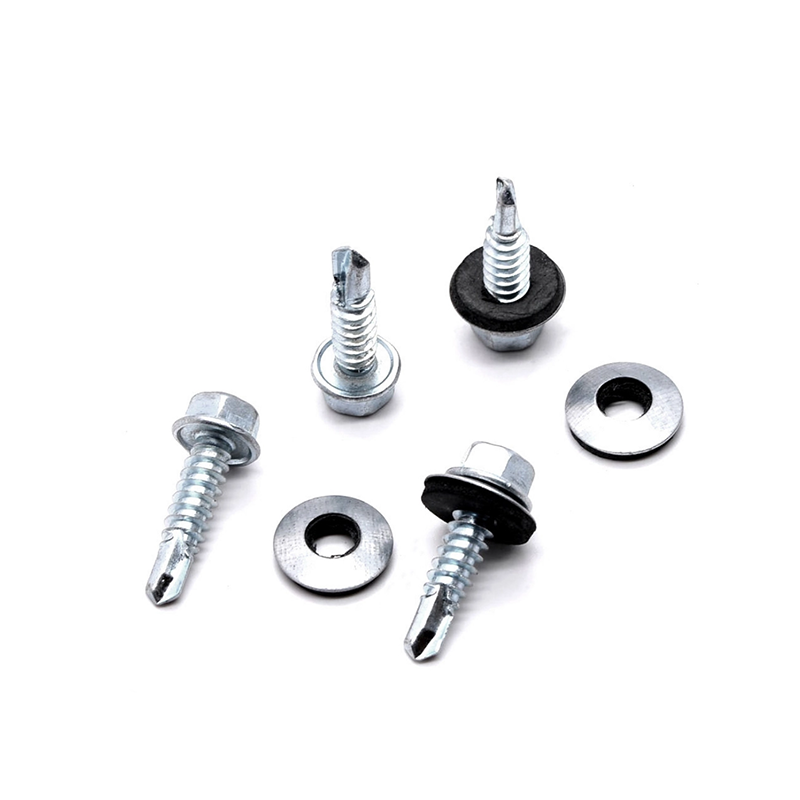
Most hex head self-drilling screws used in external environments feature an EPDM (synthetic rubber) washer bonded to a metal backing. This component is the primary defense against water leaks in roofing and siding applications. However, achieving the “Goldilocks” level of compression—not too much, not too little—is a skill that many installers ignore.
The Risks of Over-Compression
When a screw is driven too tightly, the EPDM rubber is forced outward, often “mushrooming” past the edge of the metal washer.
- UV Degradation: Once the rubber is splayed out and exposed to direct sunlight, it degrades much faster. Within a few seasons, the over-extended rubber will crack and perish.
- Seal Failure: Excessive pressure can actually tear the bond between the rubber and the metal washer, creating a direct path for water to travel down the screw shank and into the building envelope.
The Consequences of Under-Compression
Conversely, if the screw is under-driven, the washer remains loose and fails to form a concave seal against the metal panel. This allows “capillary action” to pull moisture under the washer. In freezing climates, this moisture can freeze and expand, further loosening the fastener and eventually leading to significant leaks.
The Visual “Perfect Seal” Test
A correctly installed hex head screw should show the EPDM washer firmly compressed so that it is slightly visible at the edge of the metal backing, but not bulging or deformed. The metal washer should remain flat or slightly concave. If the metal washer is convex (bowed upward), the screw is over-tightened. Using a drill with a depth-sensitive nosepiece is the most effective way to achieve consistent washer compression across thousands of fasteners.
Applying Incorrect or Inconsistent Downward Pressure
A self-drilling screw is essentially a miniature drill bit. For any drill bit to work, it requires a specific “feed rate”—the speed at which the tool moves into the material. In the case of screws, the feed rate is determined by the amount of downward pressure applied by the installer.
The “Feathering” Mistake
Many inexperienced installers apply very light pressure, waiting for the screw to “catch” the metal. This is a mistake. When you apply light pressure at high RPM, the drill point simply rubs against the surface without biting. This causes the tip to heat up instantly and can also cause the screw to “walk” or skitter across the metal sheet, scratching the protective zinc or paint coating and inviting premature rust.
The Efficiency of the “Curled Chip”
To install a hex head self-drilling screw correctly, you should apply steady, linear pressure (roughly 25–35 lbs of force). You know you are doing it right when the screw produces curled metal chips rather than fine metallic dust. Curled chips are a sign that the cutting edges are properly engaged and that the heat is being carried away by the chips rather than staying in the screw tip.
Ergonomics and Alignment
Always ensure your body is positioned so that you are pushing in a perfectly straight line with the screw. If you apply pressure at an angle, you increase the risk of “cam-out” or snapping the screw. In modern B2B construction, ergonomic extensions and stand-up driving tools are used to maintain this consistent pressure while reducing worker fatigue, leading to higher quality installations across large surface areas.
Ignoring Material Compatibility and Galvanic Corrosion
The final, and perhaps most expensive, mistake is failing to consider the chemical relationship between the screw and the material it is fastening. Even a perfectly installed screw will fail if it is eaten away by corrosion within a few years.
The Science of Galvanic Corrosion
When two dissimilar metals (like a carbon steel screw and an aluminum panel) are in contact in a moist environment, they form a “galvanic cell.” The less noble metal becomes an anode and begins to corrode at an accelerated rate.
- Steel on Aluminum: If you use standard zinc-plated screws on aluminum roofing, the zinc will be sacrificed quickly, and the steel screw will soon follow, leading to “red rust” streaks and eventually structural failure.
- The Coastal Factor: In environments within 5 miles of the ocean, the salt in the air acts as a catalyst for this process. In these areas, standard plating is insufficient.
Choosing the Right Protection
For high-end or industrial applications, you must match the screw material to the environment.
- Bi-Metal Screws: These feature a 300-series stainless steel body for ultimate corrosion resistance, with a hardened carbon steel tip welded on to provide the drilling capability.
- Specialized Coatings: Modern B2B fasteners often feature organic or ceramic coatings (such as Ruspert, Magni, or Climaseal) that are rated for 1,000+ hours of salt spray testing. Never assume a “shiny” screw is a “protected” screw; always verify the coating specifications against your project’s environmental requirements.
Comparison: Self-Drilling Screw Selection Table
| Screw Type | Best For | Max Thickness (Point #3) | Corrosion Resistance |
|---|---|---|---|
| Zinc-Plated Carbon Steel | Indoor / Dry environments | Up to 0.210" | Low |
| Grade 410 Stainless | Hard metal / Outdoor | Up to 0.175" | Medium (High Strength) |
| Bi-Metal (304 Stainless) | Coastal / Aluminum | Up to 0.150" | Excellent |
| Point #5 Heavy-Duty | Structural beams / Plate | Up to 0.500" | Medium-High |
FAQ: Professional Fastening Insights
Why are my hex head screws “walking” or skating across the metal before drilling?
This is usually caused by using a drill point that is too large for a thin sheet of metal, or not applying enough initial downward pressure. If you are drilling into thin-gauge sheet metal, a Point #2 is often better than a Point #3 because it has a sharper, more immediate “bite.”
Can I use an impact driver to install these screws?
While possible, it is not recommended for high-precision work. The uncontrolled torque of an impact driver often over-tightens the washer or snaps the screw head. A dedicated screw gun with a clutch is the superior tool for the job.
Is it okay to reuse a self-drilling screw if I missed the first time?
Generally, no. The drill point is a single-use cutting tool. Once it has drilled through a piece of steel, the cutting edges are dulled. Reusing the screw often results in extreme heat and point failure on the second attempt.
What does “Teks” mean in relation to these screws?
“Teks” was the original brand name for self-drilling screws developed by ITW Buildex. Over time, the name has become a genericized trademark used by many in the industry to refer to any self-drilling screw.
References and Citations
- SAE J78: Steel Self-Drilling Tapping Screws - Performance and Application Standards.
- ASTM C1513: Standard Specification for Steel Tapping Screws for Cold-Formed Steel Framing Connections.
- Fastener Industry Coalition (FIC): Technical Bulletin on Galvanic Corrosion in Metal Building Envelopes.
- SFS Group: A Guide to Mechanical Fasteners in Industrial Roofing and Siding (2025 Edition).
 Get In Touch
From concept to production, we cah create the products you want.
 Products
- · SCREWS
- · HEXAGONAL NUTS
- · THREADED BOLTS
- · EXPANSION ANCHORS & PLUGS
- · WIRE SCREW HOOKS
- · SCREW WASHERS
Contact Information Tel: 86-574-62101087
 E-mail: [email protected]
- E-mail: [email protected]
 Add: Xiaocao 'e Binhai Industrial Park, Yuyao, Zhejiang, China
Copyright 2024 Yuyao Cili Machinery Co., Ltd. All Rights Reserved.
 Custom Drilling Screws Manufacturers
Custom Drilling Screws Manufacturers