

 English
 русский
A Practical Guide to Wire Screw Hooks: Types, Materials, and Installation
 2026.11.02
 Industry news
Wire screw hooks are the sort of part that hardly earns a second glance on a purchase order, yet they decide whether a cable run stays tidy for a decade or sags loose in a single season. We have spent years cold heading, bending and thread rolling hooks, screws and anchors in Yuyao, and the lessons keep repeating themselves: the shape of the bend, the way the shank is threaded, and the material it bites into matter far more than the price per thousand pieces.
What follows is a practical walk through the main wire screw hook styles, the materials and finishes that suit different environments, and the small installation habits that keep a hook exactly where it was put.
What a Wire Screw Hook Is and Where It Fits
A wire screw hook is a one-piece fastener with a bend at one end and a fastening feature at the other. Most start life as low-carbon steel wire or stainless rod, cut to length, cold headed or upset at the shank end, bent into a hook or loop, and then thread rolled. Because the hook and the thread come from the same piece of metal, there is no joint to work loose, which is why this family of fasteners is so widely used for hanging, tying back and light pulling duties.
The thread is where most of the engineering hides. A coarse wood thread with a sharp point drives into timber and holds well in softwood joists. A machine thread pairs with a nut or a tapped hole. A self-tapping or hi-lo thread cuts its own path into thin sheet metal, plastic plugs or light gauge framing. Choosing the wrong thread for the substrate is the single most common reason a hook pulls out under load.
The other decision is shoulder or no shoulder. A shoulder is a small collar formed just below the bend that seats against the surface and stops the hook from being driven deeper than intended. It spreads load across a wider area and keeps the hook standing square, which matters when the item being hung needs to swing freely. Plain shanks rely entirely on thread engagement, so they suit softer materials where the hook can sink flush.
A Quick Comparison of the Common Hook Forms
Buyers often use the words "hook" and "eye" interchangeably, but the forms behave differently under load. The table below is the shorthand we use when talking a customer through a first sample order.
| Hook form | Typical construction | Usual application | Detail to confirm |
|---|---|---|---|
| Ceiling hook | Coarse wood thread, open hook | Pendant lights, plants, cable drops from joists | Hook opening and thread length |
| Cup hook | Short shank, small open hook | Mugs, keys, tools under shelves | Shoulder seating and bend closure |
| Eye screw | Closed loop on a threaded shank | Rope ends, cable guides, swivel points | Loop closure and concentricity |
| Square hook | Square bend, shoulder or plain | Tie-backs where swinging must be limited | Bend radius and shank alignment |
| Gate hook with eye | Hook plus matching eye plate | Garden gates, doors, light latches | Matching alignment of hook and eye |
| Hitching ring screw | Loose or fixed ring on a shank | Animal ties, tarpaulins, rope anchors | Ring freedom and shank length |
| J bolt | J-shaped threaded rod | Pipe support, beam clamps, embedment | Thread length and bend tolerance |
| S hook | Double open bend, unthreaded | Temporary hanging, chain links | Wire diameter and opening gap |
Matching the Hook to the Job
Overhead hanging
Anything hung above head height deserves a hook with a real thread length, not just enough turns to look convincing. In timber joists a coarse-threaded ceiling hook driven into a correctly sized pilot hole will carry far more than the same hook forced into an undersized hole, where the wood fibres shear instead of gripping. Keep the hook opening just wide enough for the fixture so the load sits at the bottom of the bend rather than on the tip.
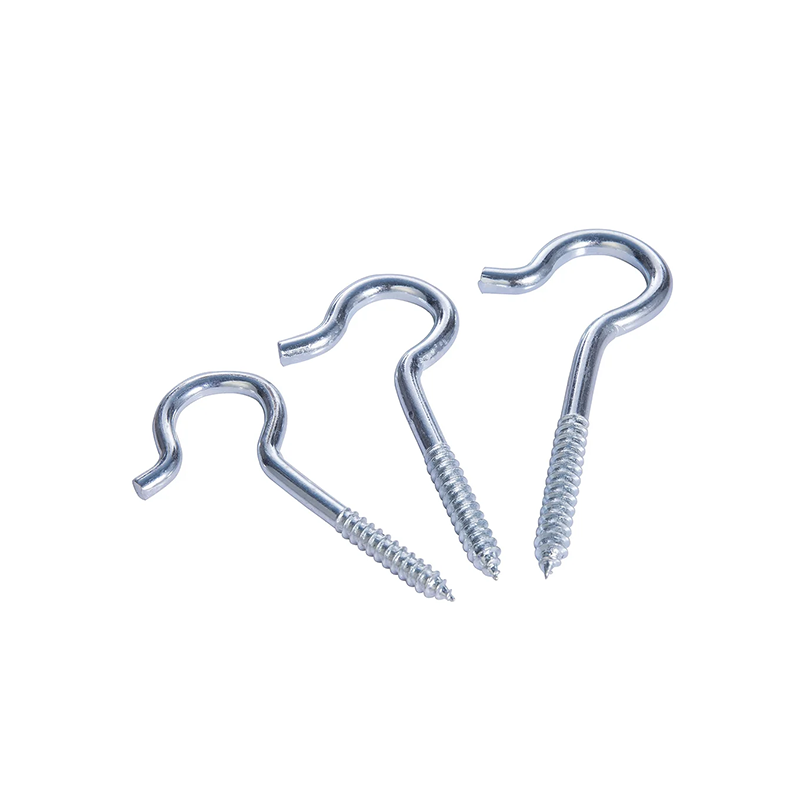 Ceiling Hooks in Steel, Stainless Steel, and BrassCeiling hooks are offered in steel, stainless steel, and solid brass with plated or plain finishes for overhead hanging where thread length matters.View Product →
Cupboards, closets and light storage
Cup hooks live in the low-load, high-frequency part of the job: a mug, a bunch of keys, a pair of scissors. What matters here is a clean bend that will not open up after the hundredth use, and a shoulder that lets the hook sit flat against the underside of a shelf. Blunt or cracked bends are a giveaway of poor forming tools, and they are the first thing to fail.
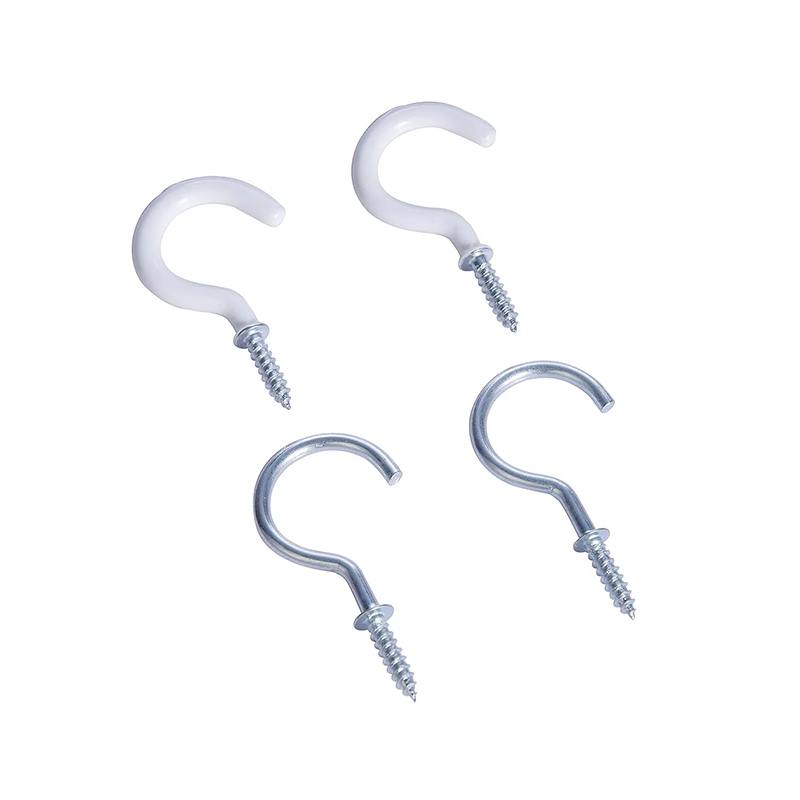 Shoulder and Non-Shoulder Cup HooksCup hooks in shoulder and non-shoulder variants, available in steel, stainless steel, and solid brass with plated, vinyl-coated, or plain finishes for light everyday hanging.View Product →
Cable, rope and swivel points
Where a rope or cable has to run through a guide, an eye screw is usually the better answer than an open hook, because a closed loop cannot spill the line when tension slackens. Check that the loop is properly closed and that the eye sits in line with the shank; a loop bent off-axis will twist as it is driven and can snap at the shoulder.
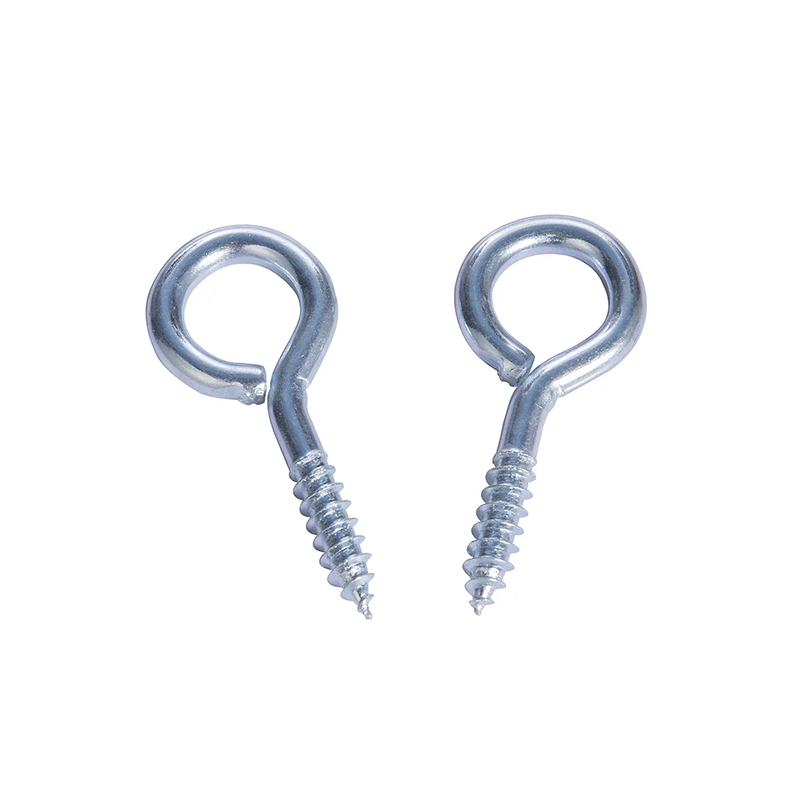 Eye Screws, Shoulder/Non-shoulderSteel, Stainless Steel, Solid BrassView Product →
Gates, tie-backs and heavier pulls
Square hooks, gate hooks with matching eyes, hitching rings and J bolts all take side loads rather than pure vertical ones. Here the bend geometry does the work, so specify the wire diameter and bend radius together rather than treating them as separate line items. For anything embedded in concrete or used to clamp pipework, a J bolt with a generous thread length gives the installer room to adjust.
Material and Finish Choices That Suit the Environment
Indoors and dry, low-carbon steel with zinc plating is usually the sensible balance of cost and corrosion resistance. In coastal air, wash-down areas, or anywhere the hook will sit in damp timber, stainless steel earns its premium quickly; the extra cost is trivial compared with replacing failed hooks inside a finished wall. For decorative work, brass or bronze finishes are chosen for appearance as much as protection.
- Zinc plating: general indoor use and sheltered outdoor work.
- Hot-dip galvanizing: heavier outdoor exposure where a thicker coating is acceptable.
- Stainless steel: marine air, food areas, humid interiors and long-service installations.
- Black oxide or plain finish: typically for parts that will be painted or used in dry, controlled conditions.
Load figures deserve the same honesty as finish. Published working loads for small hooks are modest, and a safety factor should always sit between the rated figure and the real duty. If a hook is going to hold something that would hurt a person if it fell, size up rather than shave the margin.
Installation Habits That Keep a Hook Tight
Most hook failures we are asked to investigate are not manufacturing defects. They are installation choices, and they are easy to correct.
- Drill the pilot hole to the recommended diameter for the thread and the substrate; undersized holes split timber and oversized holes strip it.
- Drive the hook until the shoulder seats, not until the arm aches. Over-torqueing stretches the shank and weakens the bend.
- Keep the load at the bottom of the bend so the hook is pulled in line with its shank rather than levered sideways.
- Add a small pilot hole or a thread-locking measure where vibration is constant, such as near machinery or on swinging doors.
- Re-check hooks on moving assemblies periodically, since cyclical loading loosens even well-seated fasteners over time.
We wrote a fuller note on preventing a hook from working loose under vibration, which is worth reading if your application involves pumps, doors or anything else that keeps moving.
Ordering Wire Screw Hooks to Your Own Drawing
Off-the-shelf hooks cover most everyday jobs, but plenty of projects need something slightly different: a longer shank, a narrower opening, a shoulder in a position that clears a bracket, or a thread that matches an existing tapped hole. Our factory in Yuyao runs wire drawing, annealing, cold heading, bending and thread rolling under one roof, with ISO 9001-2008 certification and a monthly output of roughly 1,000 tonnes, so a modified hook is usually a tooling question rather than a supply question.
When you send a sample or a drawing, the details that speed things up are the wire diameter, the hook opening and bend radius, the thread type and length, the material and finish, and the load the part must carry. Photographs of the failed part you are replacing help too, because a fracture pattern often explains more than a dimension sheet. You can browse our full wire hook range to see how the standard families are grouped before deciding what to customize.
Our team works in English and Russian, and enquiries usually start with a drawing and a target quantity. From there we quote, sample and confirm before production, which keeps surprises in the sample stage where they are cheap to fix.
A wire screw hook is a small purchase with a long life in front of it. Getting the thread, the shoulder and the material right at the ordering stage takes a few extra minutes and saves a great deal of climbing, unscrewing and re-drilling later. If you are unsure which form suits your application, describe the substrate and the load, and we will point you to the shape that has worked for similar jobs before.
 Get In Touch
From concept to production, we cah create the products you want.
 Products
- · SCREWS
- · HEXAGONAL NUTS
- · THREADED BOLTS
- · EXPANSION ANCHORS & PLUGS
- · WIRE SCREW HOOKS
- · SCREW WASHERS
Contact Information Tel: 86-574-62101087
 E-mail: [email protected]
- E-mail: [email protected]
 Add: Xiaocao 'e Binhai Industrial Park, Yuyao, Zhejiang, China
Copyright 2024 Yuyao Cili Machinery Co., Ltd. All Rights Reserved.
 Custom Drilling Screws Manufacturers