

 English
 русский
Stainless Steel vs. Galvanized vs. Coated: Which Decking Screws Should You Use?
 2026.06.08
 Industry news
The Short Answer: Which Decking Screw Should You Use?
Before diving into the details, here's the direct answer: for most residential decks using pressure-treated lumber, a high-quality coated or hot-dip galvanized screw is the best value. For coastal environments, hardwood decks, or premium builds where long-term aesthetics matter, type 316 stainless steel is the professional standard. The wrong choice leads to rust stains, screw failure, and costly board replacement — often within just a few years.
Decking screws are one of the most consequential material decisions in any deck build. A typical 400 sq ft deck uses between 1,000 and 1,500 screws — replacing them means pulling up every board. Getting the specification right from the start protects your investment for decades.
Why Decking Screw Material Matters More Than Most Builders Realize
Deck screws operate in one of the harshest environments any fastener faces: constant moisture cycles, UV exposure, thermal expansion and contraction, and direct contact with chemically treated wood. Modern pressure-treated lumber uses alkaline copper quaternary (ACQ) or copper azole (CA) preservatives — both significantly more corrosive to metal than the older chromated copper arsenate (CCA) treatments they replaced.
Studies by the American Wood Protection Association found that ACQ-treated lumber can corrode standard electro-galvanized fasteners up to 8 times faster than the older CCA lumber. A screw that looks fine at installation can be structurally compromised within 2–3 years if the wrong material is used. The result: rust bleed staining the deck surface, screw heads snapping off during board replacement, and in worst cases, structural fastener failure in load-bearing connections.
Stainless Steel Decking Screws: Maximum Corrosion Resistance
Stainless steel screws are the premium choice for decking — and for good reason. They contain chromium (typically 16–18%) that forms a passive oxide layer on the surface, providing inherent corrosion resistance without any coating that can chip, scratch, or wear away over time.
Type 304 vs. Type 316 Stainless Steel
Not all stainless steel is equal. For decking, two grades dominate:
- Type 304 stainless steel — the most common grade, containing 18% chromium and 8% nickel. Suitable for most inland residential decks but can show surface rust ("tea staining") in high-salt or coastal environments.
- Type 316 stainless steel — contains an additional 2–3% molybdenum, which dramatically improves resistance to chloride corrosion. The required standard for coastal builds within 1 mile of saltwater, and strongly recommended for any premium or commercial deck project.
Advantages of Stainless Steel Decking Screws
- No coating to degrade — corrosion resistance is intrinsic to the material, not dependent on surface treatment integrity.
- No rust staining — eliminates the brown bleed marks that ruin the appearance of light-colored deck boards.
- Compatible with all pressure-treated lumber — including high-retention ACQ and CA treatments that aggressively corrode other metals.
- Excellent for hardwoods — the natural tannins and oils in hardwoods like ipe, teak, and cumaru can accelerate corrosion in lesser screws; stainless is immune.
- Lifespan of 50+ years in most environments when properly specified.
Disadvantages of Stainless Steel Decking Screws
- Higher cost — typically 3–5 times more expensive than coated screws per unit.
- Lower hardness — stainless steel is softer than hardened carbon steel, making it more prone to cam-out (driver slipping) and head stripping if over-torqued. Use a driver with adjustable clutch settings.
- Galling risk — stainless can seize or "gall" during installation if driven too fast. Drive at lower RPM and use a lubricant (beeswax works well) to prevent this.
Galvanized Decking Screws: Reliable Mid-Range Protection
Galvanized screws are coated with zinc, which acts as a sacrificial barrier — the zinc corrodes preferentially, protecting the steel underneath. However, not all galvanized screws offer the same level of protection. The method of galvanizing makes a critical difference.
Electro-Galvanized (EG)
Electro-galvanizing deposits a thin layer of zinc (typically 0.2–0.3 mils / 5–8 microns) through an electrochemical process. The result is a smooth, bright finish — but the zinc layer is far too thin for outdoor decking applications. Electro-galvanized screws are not suitable for pressure-treated lumber or outdoor exposure and will corrode rapidly. They are intended for interior applications only.
Hot-Dip Galvanized (HDG)
Hot-dip galvanizing immerses the fastener in molten zinc at approximately 450°C (840°F), producing a much thicker coating — typically 1.7–3.9 mils (43–100 microns). This thick zinc layer provides genuine outdoor durability and is the minimum standard accepted by most building codes for use with ACQ pressure-treated lumber.
The International Residential Code (IRC) and most North American building codes require fasteners used with ACQ or CA treated lumber to meet ASTM A153 hot-dip galvanized standard or equivalent. Always verify compliance before purchasing.
Advantages of Hot-Dip Galvanized Screws
- Code-compliant for pressure-treated lumber in most jurisdictions.
- More affordable than stainless — typically 1.5–2x the cost of standard coated screws but significantly less than stainless.
- Good lifespan — 15–25 years in typical inland residential environments.
Disadvantages of Hot-Dip Galvanized Screws
- Rough texture — the thick zinc coating can be uneven, which affects thread engagement and driving consistency.
- Not suitable for coastal environments — zinc corrodes in high-chloride conditions; stainless is required near saltwater.
- Can still stain — as the zinc layer weathers, some light staining around screw heads may occur over time.
Coated Decking Screws: The Everyday Workhorse
Coated decking screws — also called polymer-coated, epoxy-coated, or proprietary-finish screws — are hardened carbon steel screws with a corrosion-resistant organic or ceramic coating applied after hardening. Brands like GRK, Headlok, FastenMaster, and Spax have developed proprietary coating technologies that in some cases rival or exceed the corrosion resistance of hot-dip galvanized at a fraction of the weight and with a more consistent finish.
What to Look for in Coated Screws
Coating quality varies enormously between manufacturers. Evaluate coated screws using these criteria:
- Salt spray test hours — quality coated decking screws should pass a minimum of 1,000–2,000 hours in ASTM B117 salt spray testing. Premium products like GRK RSS screws are rated to 10,000+ hours.
- ACQ/CA compatibility certification — confirm the manufacturer explicitly states compatibility with current pressure-treated lumber formulations.
- Coating thickness and uniformity — thicker, more uniform coatings last longer and resist chipping during installation.
Advantages of Coated Decking Screws
- Hardened steel core — coated screws are made from hardened carbon steel, giving them higher shear strength than stainless steel equivalents.
- Sharp, consistent threads — hardened steel holds thread geometry better, reducing cam-out and improving drive consistency.
- Wide availability and competitive pricing — coated screws are the most commonly stocked decking fastener at most builders' merchants.
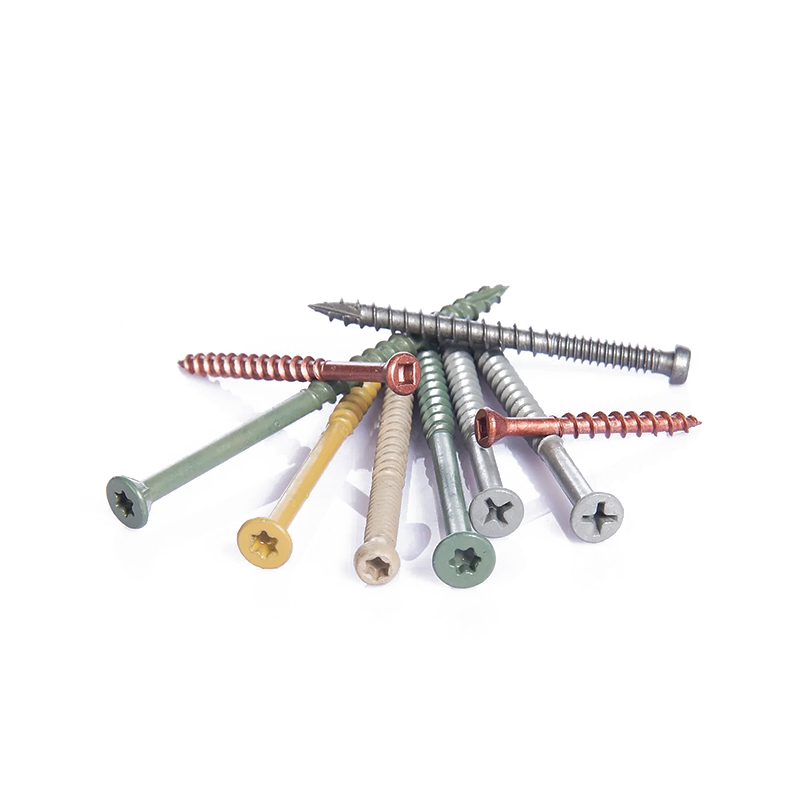
- Color options — many coated screws are available in brown, tan, gray, or black to blend with deck board colors.
Disadvantages of Coated Decking Screws
- Coating can be damaged during installation — if the driver bit cams out, the coating in the screw recess can chip, exposing bare steel.
- Performance varies significantly by brand — cheap coated screws offer little more protection than bare steel. Brand and specification matter enormously.
- Not recommended for coastal or tropical environments — in high-humidity or salt-air conditions, stainless remains the safer choice.
Head-to-Head Comparison: Stainless vs. Galvanized vs. Coated
| Factor | Stainless Steel (316) | Hot-Dip Galvanized | Premium Coated |
|---|---|---|---|
| Corrosion Resistance | Excellent | Good | Good–Very Good |
| Coastal/Saltwater Suitability | Yes | No | No |
| ACQ/CA PT Lumber Compatible | Yes | Yes (ASTM A153) | Yes (verify brand) |
| Hardwood Compatibility | Excellent | Moderate | Good |
| Shear Strength | Moderate | Moderate | High |
| Rust Staining Risk | None | Low | Low (if undamaged) |
| Expected Lifespan | 50+ years | 15–25 years | 15–20 years |
| Relative Cost (per 100 screws) | $$$$ (highest) | $$ (mid) | $–$$$ (varies by brand) |
| Ease of Installation | Moderate (galling risk) | Moderate (rough finish) | Easy |
Choosing by Deck Material: What Works With What
The deck board material is just as important as the environment when selecting screws. Here's the right match for each common decking type.
Pressure-Treated Pine or Fir
The most common decking material in North America. ACQ and CA treatments are highly corrosive. Minimum requirement: ASTM A153 hot-dip galvanized or equivalent coated screws. For longevity and zero staining, 316 stainless is the upgrade worth considering. Never use electro-galvanized screws with PT lumber — they will fail.
Composite Decking (Trex, TimberTech, Fiberon)
Most composite decking manufacturers require specific screw types and sizes to maintain their warranties — always consult the manufacturer's installation guide before purchasing fasteners. Many composite decks use hidden fastener systems. Where face screws are used, coated screws in colors matched to the board are standard. Stainless is also acceptable and preferred for coastal installations.
Hardwood Decking (Ipe, Teak, Cumaru, Garapa)
Tropical hardwoods are extremely dense (ipe has a Janka hardness of 3,510 lbf, more than three times that of Southern yellow pine) and contain natural oils and tannins that accelerate corrosion in zinc-coated fasteners. Type 316 stainless steel is the only recommended screw material for tropical hardwood decks. Pre-drilling is essential — even with stainless — to prevent splitting and reduce the risk of screw shear.
Cedar and Redwood
Cedar and redwood contain tannic acid that reacts with iron and standard zinc coatings to produce dark blue-black staining around screw heads — a permanent and unsightly reaction. Stainless steel is strongly recommended for both species. If budget requires coated screws, choose a product specifically listed as tannin-resistant by the manufacturer.
PVC Decking
PVC boards have high thermal expansion — up to 3x more than wood — and require screws that allow for movement without cracking the board. Most PVC deck manufacturers specify stainless or coated screws with a pan or modified truss head that distributes load across a wider surface area. Hidden fastener systems are generally preferred.
Decking Screw Size and Thread Guide
Selecting the correct screw size is just as important as selecting the right material. Using a screw that is too short risks board pull-out; too long and you risk penetrating the joist fully and reducing holding power.
| Board Thickness | Recommended Screw Length | Typical Gauge | Thread Type |
|---|---|---|---|
| 1 in (25mm) | 2 in (50mm) | #8 | Fine / Type 17 |
| 1½ in (38mm) — standard 5/4 decking | 2½–3 in (63–75mm) | #8–#10 | Coarse / Type 17 |
| 2 in (50mm) — 2x6 decking | 3–3½ in (75–90mm) | #10 | Coarse / Bugle head |
| Hardwood (any thickness) | Board thickness × 2.5 | #10–#12 | Fine thread, pre-drill required |
The general rule: the screw should penetrate the joist by at least 1½ inches (38mm) after passing through the full board thickness. For 5/4 decking (actual 1 inch thick) on standard 1.5-inch joists, a 2½-inch screw achieves approximately 1.5 inches of joist penetration — the practical minimum.
Common Decking Screw Mistakes to Avoid
Even experienced builders make these errors. Avoiding them from the start saves time, money, and the frustration of premature deck failure.
- Using electro-galvanized screws with pressure-treated lumber: They will corrode within 2–3 years. Look for the ASTM A153 or equivalent marking on the packaging.
- Over-driving screws: Countersinking too deep breaks through the protective coating on coated screws, accelerating corrosion at exactly the point of greatest moisture exposure. Drive to flush or 1/16 inch below the surface.
- Skipping pre-drilling on hardwood: Dense hardwoods will split if screws are driven without pilot holes. Pre-drill with a bit slightly smaller than the screw shank diameter and countersink for a clean finish.
- Mixing metal types: Using stainless screws with galvanized joist hangers or aluminum flashing creates a galvanic cell that accelerates corrosion of the less noble metal. Keep all metals consistent throughout the deck assembly.
- Using drywall screws for decking: Drywall screws are made from hardened but uncoated steel with a brittle temper — they snap under the lateral loads common in decking and corrode rapidly outdoors. Always use fasteners rated and labeled specifically for exterior decking.
- Ignoring composite manufacturer specs: Using non-approved screws on a composite deck voids the board warranty — which can be worth 25–30 years of coverage on premium products. Always check the installation guide first.
The Final Verdict: Which Decking Screw Is Right for Your Project?
| Project Type | Best Choice | Acceptable Alternative |
|---|---|---|
| Inland residential PT pine deck | Premium coated (ACQ-rated) | Hot-dip galvanized |
| Coastal or saltwater environment | Type 316 stainless steel | Type 304 stainless (mild coastal only) |
| Tropical hardwood (ipe, teak) | Type 316 stainless steel | None — stainless only |
| Cedar or redwood deck | Type 304 or 316 stainless steel | Tannin-resistant coated screws |
| Composite decking | Manufacturer-specified coated screws | Stainless (verify with manufacturer) |
| PVC decking | Stainless or manufacturer-approved coated | Hidden fastener system (preferred) |
| Commercial or high-end residential build | Type 316 stainless steel | Premium coated (2,000+ hr salt spray rated) |
The cost difference between a budget screw and the right screw for a 400 sq ft deck is typically $50–$200 in materials. The cost of replacing corroded fasteners and refinishing stained boards five years later is measured in thousands. Specify correctly from the start — your deck's longevity depends on what's holding it together.
 Get In Touch
From concept to production, we cah create the products you want.
 Products
- · SCREWS
- · HEXAGONAL NUTS
- · THREADED BOLTS
- · EXPANSION ANCHORS & PLUGS
- · WIRE SCREW HOOKS
- · SCREW WASHERS
Contact Information Tel: 86-574-62101087
 E-mail: [email protected]
- E-mail: [email protected]
 Add: Xiaocao 'e Binhai Industrial Park, Yuyao, Zhejiang, China
Copyright 2024 Yuyao Cili Machinery Co., Ltd. All Rights Reserved.
 Custom Drilling Screws Manufacturers
Custom Drilling Screws Manufacturers