

 English
 русский
What Are the Different Types of Hexagonal Nuts and When Should You Use Each?
 2026.06.01
 Industry news
Hexagonal nuts come in many types, each engineered for specific load conditions, environments, and assembly requirements. The most commonly used types are standard hex nuts, nylon insert lock nuts, flange nuts, and heavy hex nuts — and choosing the wrong one can lead to joint failure, corrosion, or unsafe assemblies. Here's a complete breakdown of every major type and exactly when to use each.
Standard Hex Nut (Plain Hex Nut)
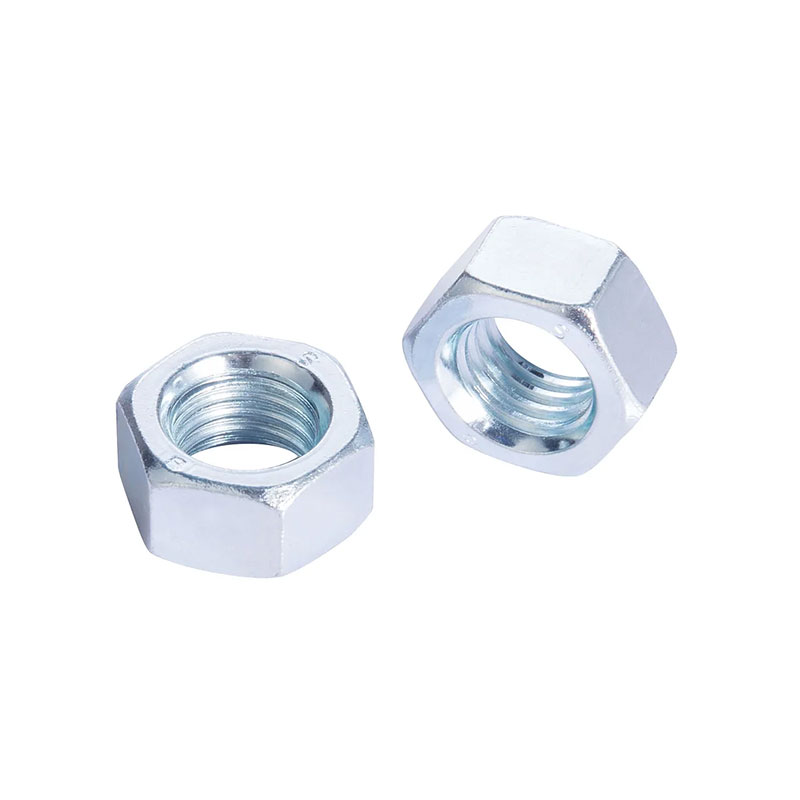
The standard hex nut is the most widely used fastener nut in the world. It features six flat sides, a uniform thickness, and an internally threaded bore. Defined by standards such as ASME B18.2.2 and ISO 4032, these nuts are available in sizes ranging from #0 to 4 inches in imperial and M1.6 to M100 in metric.
Use when: you need a general-purpose fastening solution in non-vibrating, low-to-medium load applications — such as furniture assembly, structural framing, and machinery that doesn't experience dynamic forces.
Standard hex nuts should always be paired with a washer to prevent surface damage and improve load distribution. Without vibration-resistant features, they are not suitable for engines, automotive suspensions, or industrial equipment subject to continuous movement.
Nylon Insert Lock Nut (Nyloc Nut)
The nylon insert lock nut contains a nylon collar at the top of the nut. When the bolt threads engage this collar, it creates friction that resists loosening due to vibration. This type meets DIN 985 and ASME B18.16.6 standards and is one of the most reliable passive locking solutions available.
Key limitation: nylon inserts degrade above approximately 120°C (250°F), making them unsuitable for high-temperature environments such as exhaust systems or industrial ovens.
Use when: the application involves vibration, repeated movement, or situations where re-torquing is impractical — including automotive chassis components, bicycle assemblies, electronic enclosures, and HVAC brackets. They are single-use by design; once removed, the nylon insert loses its locking effectiveness.
Flange Nut (Serrated and Non-Serrated)
Flange nuts have an integrated wide circular base (flange) that distributes clamping force over a larger surface area — functioning like a built-in washer. Serrated flange nuts add teeth on the flange underside to bite into the mating surface, providing additional vibration resistance.
| Type | Locking Feature | Best For | Avoid When |
|---|---|---|---|
| Non-serrated flange | None | Soft or delicate surfaces | High-vibration without secondary locking |
| Serrated flange | Serrations grip surface | Automotive, motorcycles, sheet metal | Coated or painted surfaces (marring) |
Use when: working with sheet metal, plastic panels, or soft materials where standard washers might shift or be omitted. Flange nuts are extremely common in automotive manufacturing — for example, exhaust manifold and wheel arch fastening — because they reduce part count and assembly time.
Heavy Hex Nut
Heavy hex nuts are larger in width across the flats and thicker than standard hex nuts of the same thread size. For example, a 1-inch heavy hex nut measures 1-5/8 inches across flats, compared to 1-1/2 inches for a standard hex nut. They conform to ASME B18.2.2 heavy series and ASTM A563 specifications.
Use when: the joint carries heavy structural or tensile loads — including steel construction (I-beams, column base plates), pipeline flanges, anchor bolt connections, and high-strength bolt assemblies (ASTM A325 or A490). They are mandatory in many structural steel applications per AISC and RCSC specifications.
Jam Nut (Half Nut)
A jam nut is approximately half the height of a standard hex nut — typically around 40–50% of the normal thickness for a given thread diameter. It is designed to be tightened ("jammed") against a standard nut to lock it in position through opposing compressive forces.
Use when: you need to lock a nut's position on a bolt or threaded rod without adding excessive stack height — common in adjustable machinery, turnbuckles, rod-end bearings, and precision equipment where positional adjustment is needed before final locking. Always install the jam nut first (closest to the workpiece), then the full nut on top, and torque them against each other.
Castle Nut (Castellated Nut)
Castle nuts feature slots (castellations) cut into the top, which align with a hole drilled through the bolt. A cotter pin or safety wire is passed through the slot and bolt hole to physically prevent the nut from rotating. This provides a positive, mechanical anti-loosening mechanism that cannot rely solely on friction.
Use when: absolute prevention of loosening is safety-critical and failure is not acceptable — such as wheel bearing retaining nuts, aircraft control linkages, steering tie rods, and applications governed by FAA, military, or motorsport regulations. Castle nuts require a pre-drilled bolt and cotter pin, adding assembly time but delivering unmatched mechanical security.
Prevailing Torque Hex Nut (All-Metal Lock Nut)
Unlike nylon insert lock nuts, all-metal prevailing torque nuts use a distorted or out-of-round thread section — often a crimped top section — to generate locking friction mechanically, without any plastic insert. Common designs include the top-lock nut and the oval lock nut.
Use when: the operating temperature exceeds the limits of nylon insert nuts — for example, in exhaust manifolds (up to 315°C / 600°F or higher depending on grade), engine mounts, or industrial furnaces. They can be reused several times before the locking torque degrades, unlike nylon versions.
Cap Nut (Acorn Nut or Dome Nut)
Cap nuts have a closed, rounded top that covers the exposed end of a bolt thread. This serves two purposes: protecting the thread from corrosion, damage, and contamination, and providing a finished, aesthetically clean appearance.
Use when: exposed threads could cause injury (sharp edges in consumer products), when thread protection from moisture or chemicals is needed, or when appearance matters — such as motorcycle bodywork, furniture, display fixtures, and handrails. Cap nuts are available in stainless steel, brass, and chrome-plated finishes for decorative applications.
Coupling Nut (Hex Connector Nut)
A coupling nut is an elongated hex nut — typically 3 to 4 times the length of a standard nut — used to join two externally threaded rods or studs end-to-end. It may feature the same thread throughout, or different threads at each end to connect incompatible thread sizes or standards.
Use when: extending the length of a threaded rod, hanging suspended ceilings or pipes from threaded rod systems, or joining threaded inserts in concrete anchoring applications. They are a standard component in all-thread rod (ATR) assemblies in construction.
Quick Selection Guide by Application
Use the table below to identify the right hex nut type based on your specific use case at a glance.
| Application Scenario | Recommended Nut Type | Key Reason |
|---|---|---|
| General static assembly | Standard hex nut | Cost-effective, widely available |
| Vibration-prone machinery (<120°C) | Nylon insert lock nut | Friction locking without surface damage |
| High-temperature environments | All-metal prevailing torque nut | No nylon to degrade at heat |
| Structural steel / heavy loads | Heavy hex nut | Greater bearing area, higher strength |
| Safety-critical locking (aircraft, wheels) | Castle nut + cotter pin | Positive mechanical retention |
| Sheet metal / soft substrates | Flange nut (serrated) | Built-in washer, no shifting |
| Positional adjustment / locking | Jam nut | Low profile, counter-torque locking |
| Thread extension / rod joining | Coupling nut | Full-length thread engagement |
| Aesthetic / protective finish | Cap nut (acorn nut) | Covers exposed threads, clean look |
Material and Coating Considerations
The type of hex nut you choose is only part of the decision. Material and surface treatment dramatically affect corrosion resistance, strength, and compatibility:
- Grade 2 / Grade 5 / Grade 8 (imperial): carbon steel nuts rated for progressively higher proof loads — Grade 8 is standard for structural and heavy-duty joints.
- A2 / A4 stainless steel (304 / 316): A4 (316) adds molybdenum for superior saltwater and chemical resistance — preferred for marine, food processing, and outdoor environments.
- Zinc-plated: provides basic corrosion protection for indoor applications; not suitable for coastal or high-humidity environments.
- Hot-dip galvanized: thick zinc coating for outdoor structural applications, typically adding 45–85 microns of protective layer.
- Brass / bronze: naturally corrosion-resistant and non-magnetic — used in electrical panels, plumbing, and marine hardware where steel is not appropriate.
Always match the nut material to the bolt material to avoid galvanic corrosion. Mixing stainless steel nuts with carbon steel bolts in a wet environment will accelerate corrosion of the carbon steel component.
 Get In Touch
From concept to production, we cah create the products you want.
 Products
- · SCREWS
- · HEXAGONAL NUTS
- · THREADED BOLTS
- · EXPANSION ANCHORS & PLUGS
- · WIRE SCREW HOOKS
- · SCREW WASHERS
Contact Information Tel: 86-574-62101087
 E-mail: [email protected]
- E-mail: [email protected]
 Add: Xiaocao 'e Binhai Industrial Park, Yuyao, Zhejiang, China
Copyright 2024 Yuyao Cili Machinery Co., Ltd. All Rights Reserved.
 Custom Drilling Screws Manufacturers
Custom Drilling Screws Manufacturers