

 English
 русский
What Is a Hexagonal Nut and Why Is It the Most Widely Used Fastener in Engineering?
 2026.05.25
 Industry news
The Direct Answer: A Six-Sided Threaded Fastener That Dominates Engineering Because of Geometry, Versatility, and Standardization
A hexagonal nut is an internally threaded fastener with six flat sides forming a regular hexagon, designed to mate with a bolt, screw, or stud of matching thread specification. It is the single most produced fastener type in the world, manufactured in the billions annually across every major industrial economy. Its dominance is not accidental: the six-sided geometry provides the optimal balance between wrenching access, material efficiency, torque transfer, and tool compatibility that no other nut geometry has matched in over 175 years of standardized production.
The sections below explain exactly what a hexagonal nut is, how it works, why the hexagon specifically outperforms all alternatives, and where it is used across engineering disciplines.
Anatomy of a Hexagonal Nut: Every Dimension Has a Purpose
Understanding what makes a hexagonal nut work requires knowing each of its geometric features and the engineering role each one plays:
Thread Form and Pitch
The internal thread is the nut's primary functional feature. It converts rotational motion into axial clamping force. Thread pitch—the distance between adjacent thread crests—determines the mechanical advantage: a finer pitch produces more clamping force per degree of rotation but is more vulnerable to cross-threading and vibration loosening. Standard hex nuts use either ISO metric coarse threads (e.g., M10 × 1.5 mm pitch) for general engineering or unified coarse (UNC) threads in imperial applications.
Width Across Flats (WAF)
The distance between two parallel opposing faces. This is the dimension that determines wrench size. For an ISO metric M10 hex nut, the WAF is 17 mm; for M20, it is 30 mm. The WAF is precisely standardized so that a single wrench size fits every compliant nut of that thread diameter globally—a standardization achievement that underlies modern assembly-line manufacturing.
Width Across Corners (WAC)
The maximum diameter of the hexagon, measured corner to corner. For a regular hexagon, WAC equals WAF × 1.1547. This dimension matters for clearance calculations—how much space is needed around the nut for it to rotate freely during installation without contacting adjacent components.
Nut Height (Thickness)
Determines how many thread turns engage the bolt. ISO 4032 standard hex nuts have a height of approximately 0.8× the nominal thread diameter—enough engagement to develop the full proof load of the bolt without unnecessary material. A nut that is too thin strips before the bolt yields; one that is too thick wastes material and adds weight without improving joint strength.
Bearing Face
The flat surface that presses against the joint material. Its area directly determines contact pressure: a larger bearing face distributes clamping force over a wider area, reducing the risk of surface indentation (embedding) into softer materials such as aluminum or timber. Heavy hex nuts have a larger bearing face than standard hex nuts for exactly this reason.
Why Six Sides? The Engineering Logic of the Hexagon
The choice of six sides is not arbitrary or historical convention—it is the result of clear geometric trade-offs that make hexagonal the optimal polygon for a fastener nut. Consider the alternatives:
| Geometry | Sides | Minimum Wrench Rotation to Re-engage | Material Efficiency | Corner Stress Concentration |
|---|---|---|---|---|
| Square | 4 | 90° | Poor (low area ratio) | High (sharp 90° corners) |
| Hexagonal | 6 | 60° | Excellent | Low (120° interior angles) |
| Octagonal | 8 | 45° | Good | Very low |
| Round (knurled) | N/A | Any angle | Best | None |
The hexagon wins for three specific reasons. First, 60° wrench rotation: in confined spaces where a wrench can only swing 60° before hitting an obstruction, a hex nut can always be advanced—a square nut requires 90° and frequently cannot be tightened in tight quarters. Second, material efficiency: a regular hexagon has the highest area-to-perimeter ratio of any practical polygon used for fasteners, meaning less raw material per nut for a given bearing face area. Third, 120° interior angles distribute stress at the corners far better than the 90° angles of a square nut, reducing the risk of corner rounding under high torque.
Octagonal nuts offer 45° re-engagement but require larger stock diameter for the same thread size, wasting material. Round nuts eliminate corners entirely but cannot be driven by standard open-end wrenches and require special spanner tools—impractical for field assembly.
The Main Types of Hexagonal Nuts and Their Specific Uses
The term "hexagonal nut" covers a family of related fasteners, each optimized for a specific condition:
Standard Hex Nut (ISO 4032 / DIN 934)
The baseline type. Used in the vast majority of general mechanical and structural assemblies. Available in property classes 5, 8, 10, and 12 (metric) corresponding to increasing strength. Class 8 is the most common for steel applications, matching a Grade 8.8 bolt.
Heavy Hex Nut (ASME B18.2.2 / ISO 4033)
Larger WAF and greater height than a standard nut of the same thread. Used in structural steelwork (ASTM A563), heavy equipment, and applications where the bearing face must distribute load over a larger area. An ASTM A563 Grade DH heavy hex nut is specified for high-strength structural bolting per AISC and RCSC standards.
Nylon Insert Lock Nut (Nyloc) (ISO 7042 / DIN 985)
A standard hex nut with a nylon collar insert at the top. The nylon deforms around the bolt thread, creating prevailing torque that resists vibration loosening without the need for thread-locking adhesive. Rated for operating temperatures up to 120°C for standard nylon; high-temperature variants use polyamide rated to 200°C.
Flange Hex Nut (ISO 4161 / DIN 6923)
Incorporates an integral washer flange at the bearing face, often with a serrated underside for additional vibration resistance. Eliminates the need for a separate washer in most applications, reducing part count and assembly time. Widely used in automotive and light machinery assembly.
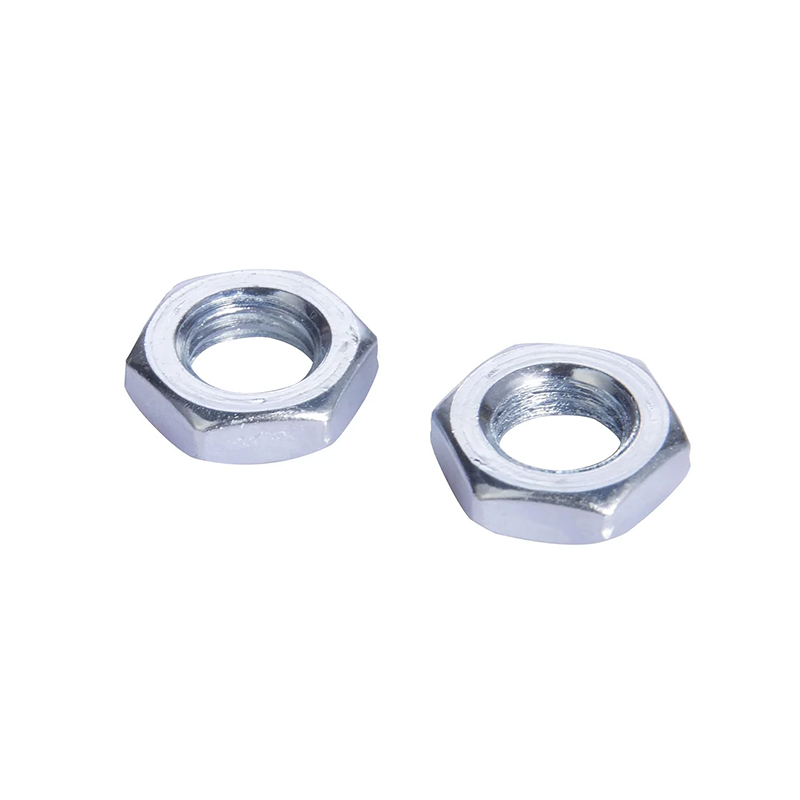
Thin Hex Nut / Jam Nut (ISO 4035 / DIN 439)
Approximately half the height of a standard hex nut. Used as a locknut in conjunction with a full nut (the jam nut is tightened against the full nut to prevent loosening), in low-clearance applications, and for fine-pitch adjustment mechanisms such as bearing preload setting.
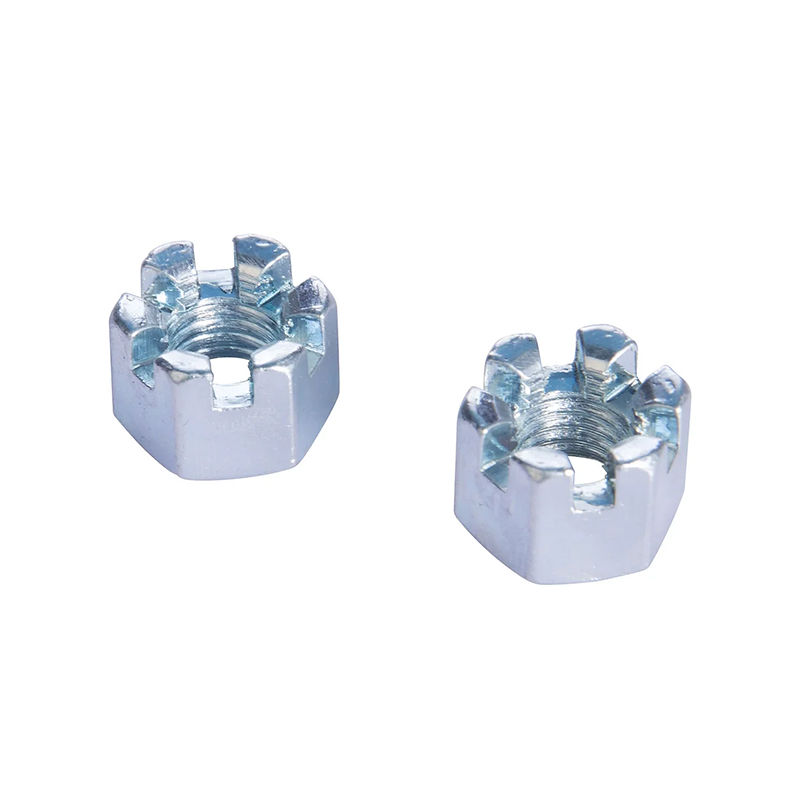
Hexagon Castle / Slotted Nut (ISO 7035 / DIN 935)
A standard hex nut with slots cut across the top, through which a cotter pin or safety wire is passed after installation to positively lock the nut against rotation. Standard in safety-critical applications including aircraft control linkages, automotive wheel bearings, and hydraulic fittings where vibration loosening would be catastrophic.
Key Dimensional Standards: ISO, DIN, and ASME Compared
Hexagonal nuts are among the most thoroughly standardized components in engineering. Understanding which standard governs your application prevents costly dimensional mismatches:
| Standard | Origin | Thread System | Key Nut Standard | Primary Markets |
|---|---|---|---|---|
| ISO | International | Metric (M) | ISO 4032, ISO 4033, ISO 4035 | Global (default for new designs) |
| DIN | Germany | Metric (M) | DIN 934, DIN 985, DIN 439 | Europe, legacy global industrial |
| ASME B18.2.2 | USA | Unified (UNC/UNF) | ASME B18.2.2 | USA, Canada, legacy UK/AU |
| ASTM A563 | USA | Unified (UNC) | ASTM A563 | USA structural steelwork |
| BS EN | UK / Europe | Metric (M) | BS EN ISO 4032 | UK, EU (harmonized with ISO) |
Where Hexagonal Nuts Are Used Across Engineering Disciplines
The hexagonal nut's combination of standardization and mechanical performance means it appears in virtually every field of engineering. The following are the highest-volume application sectors:
Structural and Civil Engineering
Heavy hex nuts per ASTM A563 are used with ASTM A325 and A490 high-strength structural bolts in steel frame connections for buildings, bridges, and towers. A single major bridge project may use over 500,000 hex nuts. The AISC and RCSC specify exact bolt/nut/washer combinations for each structural connection type, with no substitution permitted without engineering approval.
Automotive Manufacturing
A typical passenger vehicle contains between 1,500 and 3,000 threaded fasteners, the majority of which are hex nuts or hex-flanged variants. They secure suspension components, engine mounts, exhaust systems, body panels, and brake assemblies. The automotive sector drives much of the global demand for flange hex nuts and nyloc variants due to vibration requirements.
Oil, Gas, and Petrochemical
Pressure vessel flanges, pipeline connections, and valve bonnets use heavy hex nuts in alloy steel (ASTM A194 Grade 2H) and stainless steel (ASTM A194 Grade 8M) for high-temperature and high-pressure service. Flange bolt/nut assemblies in this sector are torqued in precise cross-patterns to controlled values—often exceeding 2,000 Nm for large-diameter flanges—using hydraulic torque tools.
Aerospace
Aerospace hex nuts are manufactured to far tighter tolerances than commercial grades and must meet NAS (National Aerospace Standard) or MS (Military Standard) specifications. Materials include titanium (Ti-6Al-4V) and A286 stainless steel. Every nut on a flight-critical assembly carries full material traceability documentation from raw stock through finished part.
Construction and Infrastructure
Anchor bolts securing structural columns to concrete foundations, rebar couplers, formwork systems, and pre-engineered building components all rely on hex nuts. Hot-dip galvanized hex nuts (per ASTM A153) are specified for outdoor and buried applications where corrosion protection must last 50 years or more.
How a Hex Nut Generates and Maintains Clamping Force
A bolted joint works by stretching the bolt elastically—like a stiff spring—so that the bolt's tension holds the joint members in compression. The hex nut's role is to convert the applied torque into this bolt tension efficiently and then hold that tension against service loads. The relationship is governed by the torque-tension equation:
T = K × D × F
Where T is applied torque (Nm), K is the nut factor (typically 0.15–0.20 for a lubricated steel bolt/nut), D is the nominal bolt diameter (m), and F is the resulting bolt tension (N). For a standard M16 Class 8.8 bolt tightened to its proof load:
- Proof load of M16 8.8 bolt: approximately 78,500 N (78.5 kN)
- Required torque (K = 0.18, D = 0.016 m): T = 0.18 × 0.016 × 78,500 = 226 Nm
- Of that 226 Nm, approximately 50% is consumed by thread friction, 40% by bearing face friction under the nut, and only 10% actually becomes bolt tension—which is why lubrication and surface condition have such large effects on joint preload.
The hex nut maintains this tension through the elastic interaction between bolt and joint material. As long as external service loads do not exceed the bolt's preload, the joint remains clamped and the nut does not loosen. This is why correct torque specification and application is more important than nut grade in most standard applications.
Material and Property Class: What the Numbers Mean
Hex nuts are assigned property classes (metric) or grades (imperial) that define their mechanical strength. The most important property is proof load—the maximum stress a nut can sustain without permanent deformation. A nut must be at least as strong as the bolt it mates with:
| Property Class (ISO) | Matching Bolt Class | Min. Proof Load Stress (MPa) | Typical Material | Common Application |
|---|---|---|---|---|
| 5 | 4.6 / 4.8 | 500 | Low carbon steel | Light general engineering |
| 8 | 8.8 | 800 | Medium carbon steel, Q&T | General machinery (most common) |
| 10 | 10.9 | 1,040 | Alloy steel, Q&T | Heavy machinery, automotive powertrain |
| 12 | 12.9 | 1,150 | High alloy steel, Q&T | High-performance engineering, tooling |
| A2-70 (stainless) | A2-70 bolt | 700 | 304 stainless steel | Food industry, marine, corrosion-critical |
Why No Alternative Fastener Has Displaced the Hex Nut
Several alternative fastening technologies have been developed over the past century, each targeting specific shortcomings of the bolted hex nut joint. None has achieved general displacement:
- Rivets: Permanent, lightweight, and vibration-resistant. Used extensively in aerospace and historic structural steelwork. Cannot be disassembled without destruction—eliminates repairability. Replaced by high-strength bolting in most structural applications from the 1970s onward.
- Welding: Provides a continuous joint with no discrete fastener. Requires skilled labor, heat input that can distort or weaken the base material, and cannot be disassembled at all. In most structures, welding and bolting are used together—welds for permanent connections, bolts for field-assembled or maintenance-accessible joints.
- Adhesive bonding: High strength-to-weight ratio, distributes load uniformly, excellent fatigue resistance. Cannot be disassembled; strength is highly sensitive to surface preparation; creeps under sustained load; difficult to inspect. Used in aerospace and automotive but always supplemented by mechanical fasteners at critical joints.
- Snap fits and clips: Very fast assembly, zero tools required. Load capacity far below a bolted joint; not suitable for structural applications. Confined to light-duty consumer product assembly.
The hex nut's fundamental advantage is the combination of high reversible clamping force, universal tool compatibility, full standardization across suppliers and nations, and the ability to be installed, inspected, retorqued, and replaced throughout a structure's service life. No single alternative technology offers all four properties simultaneously, which is why the hexagonal nut remains the default choice 175 years after its standardization.
 Get In Touch
From concept to production, we cah create the products you want.
 Products
- · SCREWS
- · HEXAGONAL NUTS
- · THREADED BOLTS
- · EXPANSION ANCHORS & PLUGS
- · WIRE SCREW HOOKS
- · SCREW WASHERS
Contact Information Tel: 86-574-62101087
 E-mail: [email protected]
- E-mail: [email protected]
 Add: Xiaocao 'e Binhai Industrial Park, Yuyao, Zhejiang, China
Copyright 2024 Yuyao Cili Machinery Co., Ltd. All Rights Reserved.
 Custom Drilling Screws Manufacturers
Custom Drilling Screws Manufacturers